
Research
We combine first-principles kinetic simulation, high-performance computing, and AI/ML to tackle fundamental and applied problems in plasma physics, from the laboratory to the cosmos.
Simulation software & high-performance computing
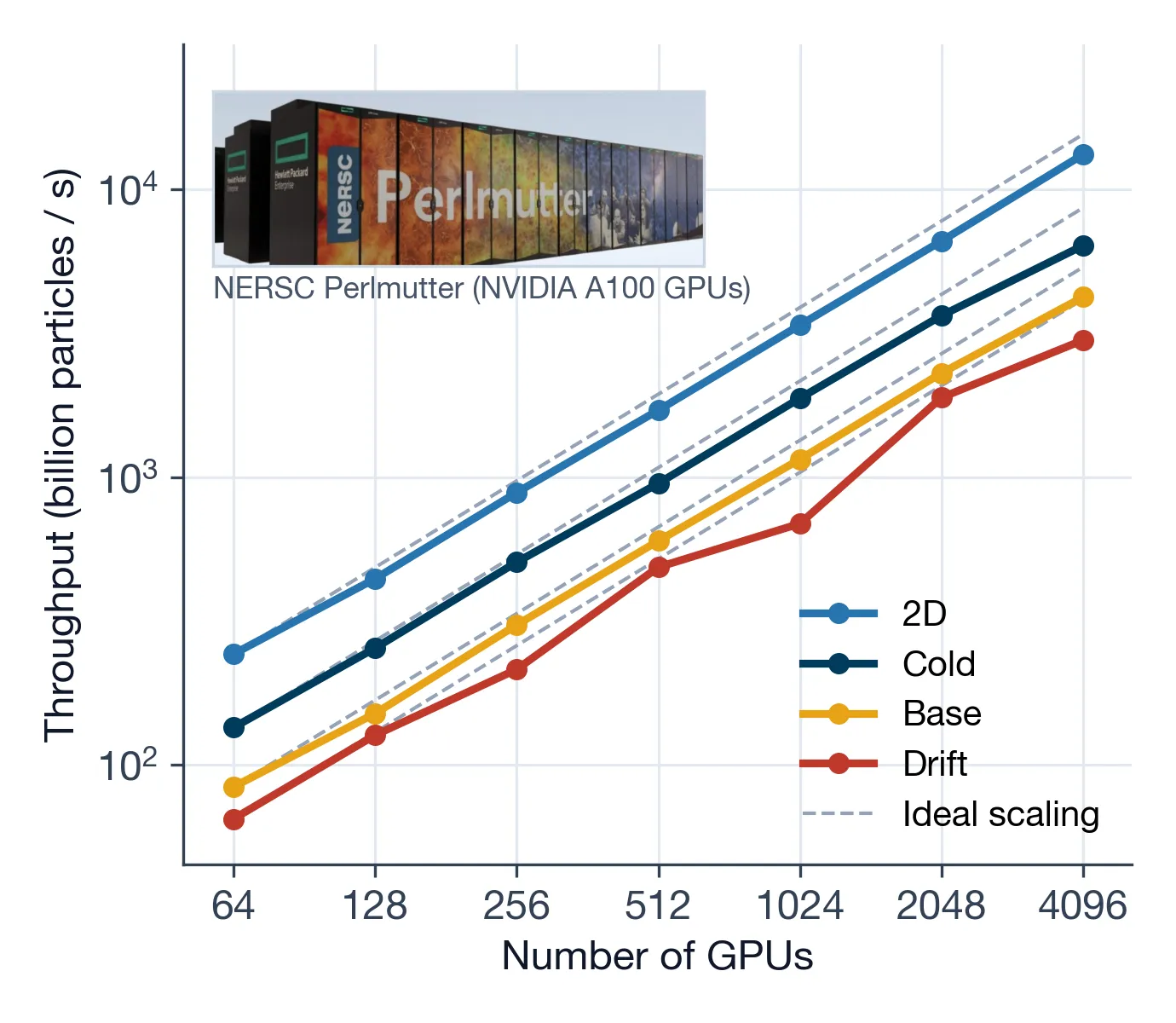
Sustainable, reusable kinetic plasma codes for the world's largest supercomputers
We believe that kinetic plasma simulation software should be sustainable, reusable and shared. Our group develops and maintains widely used particle-in-cell (PIC) and kinetic codes, including OSIRIS, QuickPIC, QPAD and OSHUN, that run on everything from a laptop to the largest supercomputers. A central part of this work is adapting our codes to new computer architectures, such as GPUs with many layers of memory and parallelism, while keeping them reliable, well-tested production tools. We study how to build PIC software from modular, well-documented components, how to combine different simulation methods (for example, collisional PIC and Vlasov–Fokker–Planck), and how to benchmark codes against one another and against well-diagnosed experiments. We also develop bare-bones “skeleton” codes and educational software, so that students and researchers at every level can understand the inner workings of optimized simulation codes, build their own, and test new ideas.
Recent publications
- An explicit algorithm in the quasi-static approximate PIC program QPAD
R. Tang, W. An, H. Wang, et al. · Plasma Physics and Controlled Fusion (2026)
- GPU-MPI parallelisation for QuickPIC, a three-dimensional quasi-static particle-in-cell algorithm
Y. Tian, Y. Wang, T. N. Dalichaouch, et al. · Journal of Plasma Physics 92, E103 (2026)
- Acceleration of the particle-in-cell code Osiris with graphics processing units
R. P. Lee, J. R. Pierce, K. G. Miller, et al. · Journal of Plasma Physics 91, E8 (2025)
AI/ML for plasma physics
Coupling machine learning with kinetic simulations to accelerate discovery
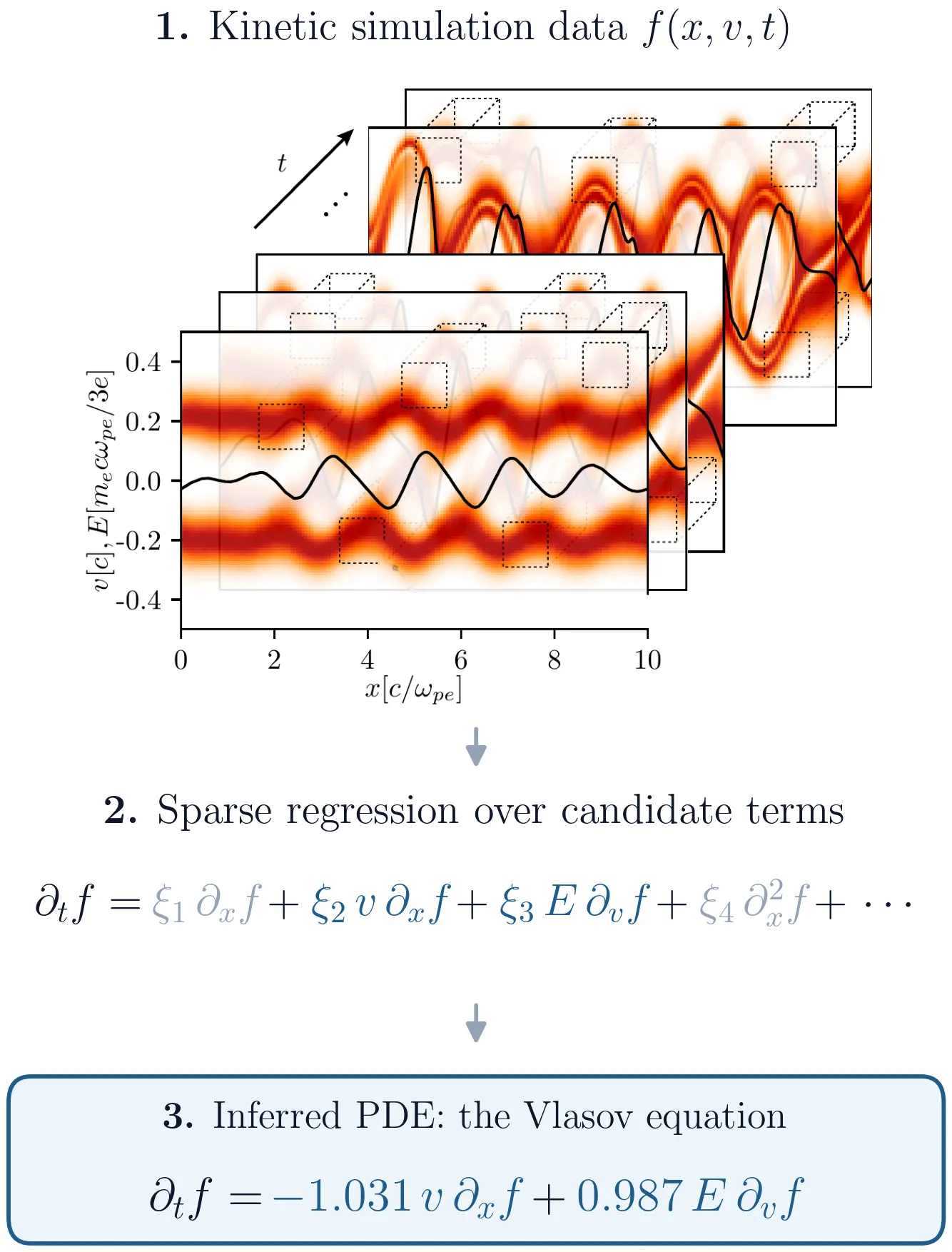
Plasmas are many-body systems whose nonlinear dynamics span an enormous range of spatial and temporal scales, which makes them challenging to describe with simple theories and to fully measure in experiments. We are developing machine-learning methods that work together with our first-principles kinetic simulations and with experimental data to accelerate discovery:
- Reduced models from simulation data: we use AI/ML to discover physically consistent, data-driven models of complex plasma phenomena, in the form of interpretable equations, directly from the data of our first-principles kinetic simulations.
- A key target is learning kinetic-fluid closure models that bridge the gap between kinetic and fluid descriptions across different phenomena.
- We showed, for example, that sparse regression can recover the hierarchy of plasma models, from the Vlasov equation to magnetohydrodynamics, from particle-in-cell data.
- To keep learned models physically consistent, we embed fundamental symmetries, such as Lorentz and Galilean invariance, through data augmentation. We also use differentiable simulators to learn operators, such as collision operators, directly from plasma phase-space data.
- Better simulation algorithms: these approaches also open a path to more accurate and efficient algorithms for multiscale plasma simulations.
- Experiments: we are developing physics-informed machine-learning tools that blend partial experimental measurements with theoretical plasma models. The aim is to reconstruct the full state of the plasma, including quantities that are difficult or impossible to measure directly, and to guide how data are collected in high-repetition-rate experiments.
Recent publications
- Data-driven discovery of reduced plasma physics models from fully kinetic simulations
E. P. Alves, F. Fiuza · Physical Review Research 4, 033192 (2022)
- Embedding physical symmetries into machine-learned reduced plasma physics models via data augmentation
M. C. McGrae-Menge, J. R. Pierce, F. Fiuza, E. P. Alves · Physical Review Research 8, 013200 (2026)
- Learning collision operators from plasma phase space data using differentiable simulators
D. D. Carvalho, P. J. Bilbao, W. B. Mori, et al. · Journal of Plasma Physics 92, E76 (2026)
Plasma-based acceleration
Laser- and beam-driven wakefield accelerators and intense laser– and beam–plasma interactions
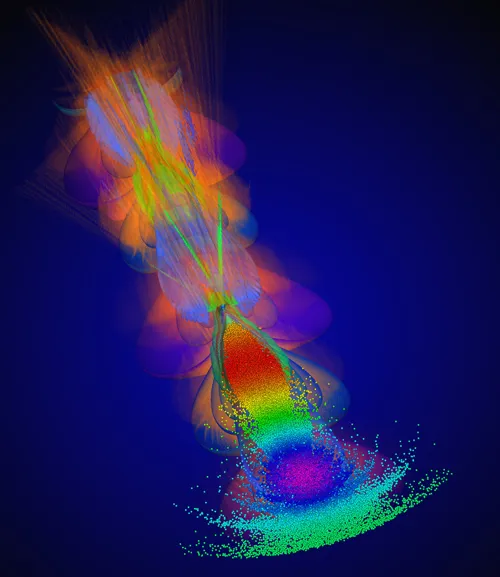
In plasma-based acceleration, an intense laser pulse or a short, dense particle beam travelling through a plasma pushes electrons aside, leaving behind a plasma wave, or wake. Electrons or positrons riding this wake can gain energy at gradients above 10 GeV/m, hundreds of times higher than in conventional radio-frequency accelerators. When a laser drives the wake, this is called laser wakefield acceleration (LWFA); when a particle beam drives it, plasma wakefield acceleration (PWFA). How the wake forms, how particles are trapped in it, how the six-dimensional phase space of the accelerated beam can be controlled, and how the driver itself evolves are all rich in nonlinear, relativistic and ultrafast physics that blends plasma, beam, accelerator and laser science. We combine theory with full-scale three-dimensional PIC simulations of ongoing and planned experiments, using simulation to test new concepts, guide experiments, and benchmark our codes against well-diagnosed measurements. Our goal is to lay the physics foundations for compact X-ray free-electron lasers and for the accelerator stages of a future linear collider.
Recent publications
- Beam Realignment with Emittance Preservation in a Plasma Wakefield-Accelerator Stage
L. Hildebrand, Y. Zhao, W. An, et al. · Physical Review Letters 135, 195002 (2025)
- Laser wakefield acceleration driven by a discrete flying focus
J. R. Pierce, K. G. Miller, F. Li, et al. · Physical Review Accelerators and Beams 28, 101303 (2025)
- The positron arm of a plasma-based linear collider
C. Joshi, W. B. Mori, M. J. Hogan · Nature Physics 21, 885-894 (2025)
Nonlinear optics of plasmas
Controlling laser–plasma instabilities in inertial confinement fusion, and using plasmas to amplify high-power, high-intensity light
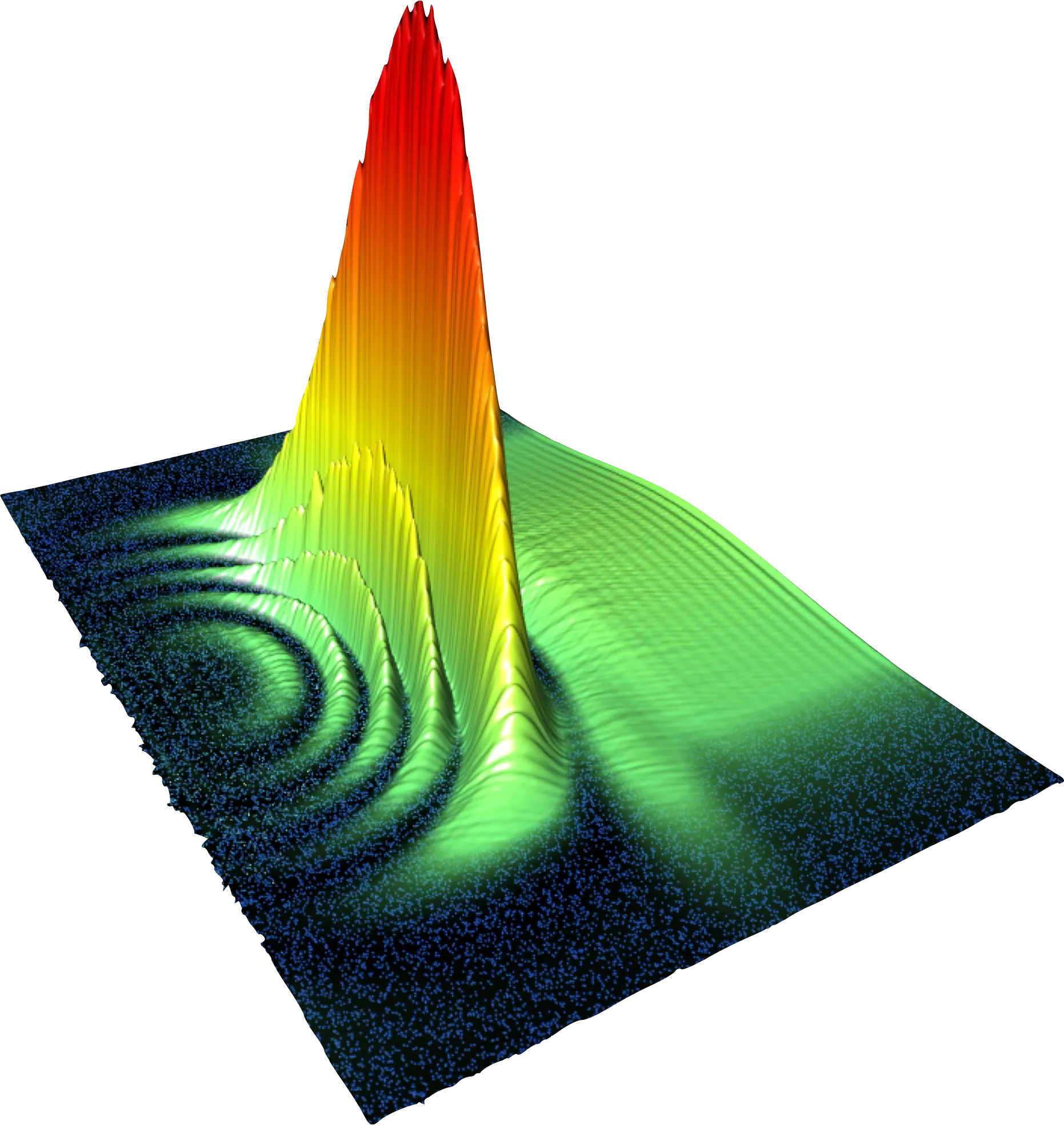
When intense laser light travels through a plasma, it can be deflected, reflected and absorbed by plasma waves that the light itself excites. These processes, which make up the nonlinear optics of plasmas, are central to inertial confinement fusion (ICF), where lasers must compress a pellet of deuterium and tritium to extreme pressures and densities to ignite fusion reactions. Laser–plasma instabilities such as stimulated Raman and Brillouin scattering, in which light scatters off electron plasma waves and ion-acoustic waves respectively, can scatter laser energy, create asymmetries that prevent the pellet from compressing evenly, and produce energetic electrons that preheat the fuel. We study how these instabilities grow and saturate, and how they can be controlled or mitigated, under conditions relevant to the National Ignition Facility and future inertial fusion energy. The same physics can also be put to use. Because plasmas are already ionized, they can withstand intensities far beyond the damage threshold of conventional optics, and Raman and Brillouin scattering can transfer energy from a long pump pulse to a short seed pulse, amplifying it to extreme powers and intensities. We are examining how to control Raman and Brillouin scattering for amplification using novel laser pulses with tailored spatiotemporal structure, such as pulses with a flying focus, whose peak intensity can move at an arbitrary velocity.
Recent publications
- Laser–plasma amplification of an ultrabroadband laser pulse to 0.3 TW
J. L. Shaw, M. V. Ambat, K. R. McMillen, et al. · Nature Photonics 20, 1070-1074 (2026)
- Generalized multi-dimensional conservation laws for stimulated Raman and Brillouin scattering in a density gradient
V. Patel, S. Chase, F. S. Tsung, et al. · Accepted in Physical Review E (2026)
- Efficient generation and amplification of intense vortex and vector laser pulses via strongly-coupled stimulated Brillouin scattering in plasmas
Y. Wu, C. Zhang, Z. Nie, et al. · Communications Physics 7, 18 (2024)
Plasma astrophysics
Magnetic field generation and particle acceleration in astrophysical plasmas
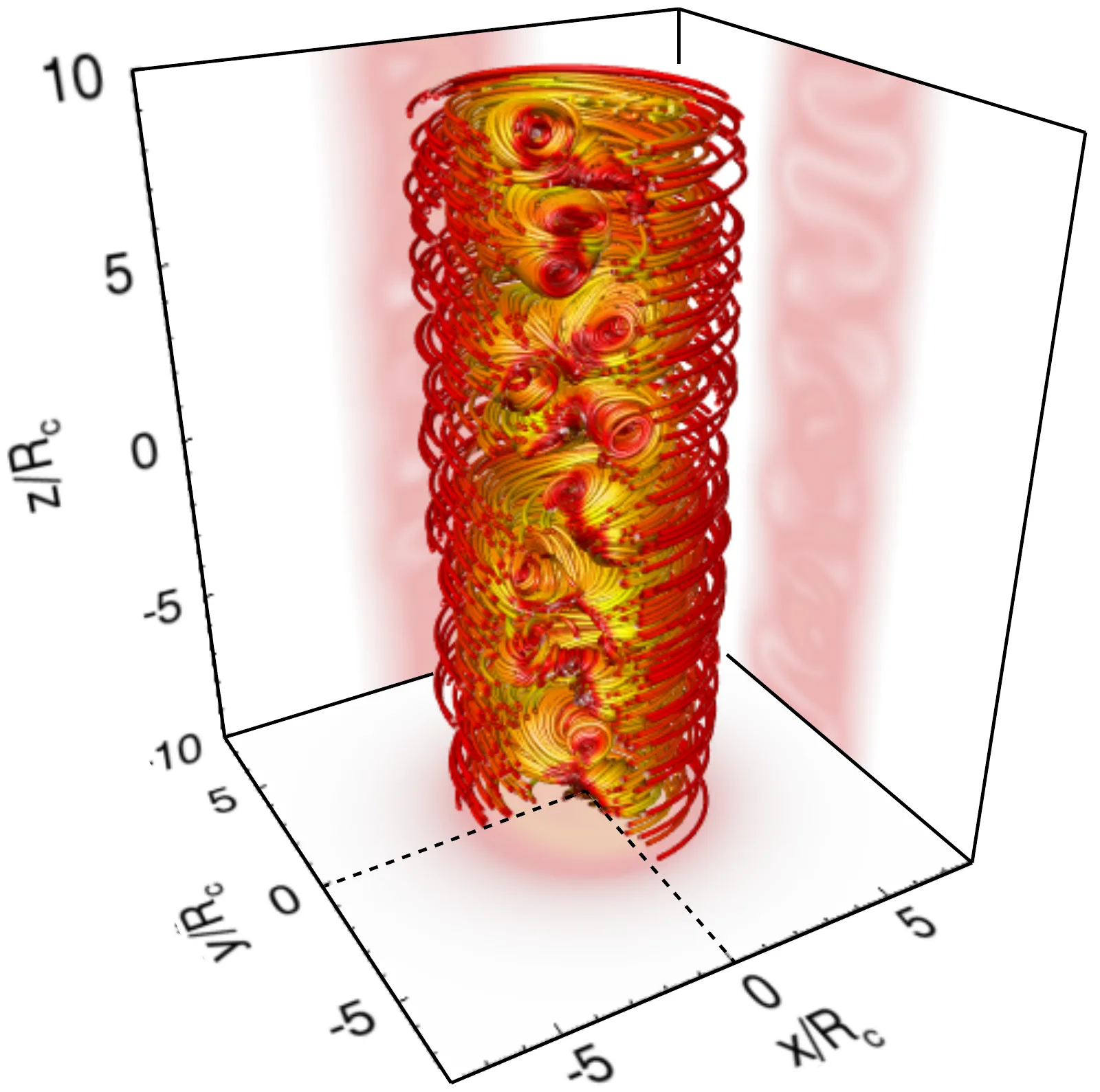
The universe is filled with magnetized plasmas, and with particles accelerated to energies far beyond anything achievable on Earth. Relativistic jets launched by active galactic nuclei and gamma-ray bursts are among the most powerful particle accelerators in the cosmos. We use large-scale, first-principles kinetic simulations to explore the plasma processes that generate and amplify magnetic fields in these environments, and to understand how the most energetic particles in the Universe are accelerated. We study how shearing flows in relativistic jets can generate and amplify magnetic fields, from electron-scale instabilities to large-scale structures, and how magnetic instabilities in jets, such as the kink instability, can convert magnetic energy into energetic particles. Our goal is to understand how efficient these acceleration processes are, what spectrum of accelerated particles they produce, and how both depend on the plasma flow and magnetic field conditions in the jet. We also identify the plasma conditions needed to reproduce these processes in laboratory experiments.
Recent publications
- Efficient Nonthermal Particle Acceleration by the Kink Instability in Relativistic Jets
E. P. Alves, J. Zrake, F. Fiuza · Physical Review Letters 121, 245101 (2018)
- Nonthermal ion acceleration by the kink instability in nonrelativistic jets
E. P. Alves, J. Zrake, F. Fiuza · Physics of Plasmas 26, 072105 (2019)
- Electron-scale shear instabilities: magnetic field generation and particle acceleration in astrophysical jets
E. P. Alves, T. Grismayer, R. A. Fonseca, L. O. Silva · New Journal of Physics 16, 035007 (2014)