
OSIRIS
Access: OSIRIS is open source. Downloads, documentation and community resources are at osiris-code.github.io.
For more than two decades, we and our collaborators in the OSIRIS consortium have developed and continue to upgrade a state-of-the-art, fully explicit, multi-dimensional, fully parallelized, fully relativistic PIC code called OSIRIS and a set of sophisticated diagnostic and visualization packages [1-2]. OSIRIS is a mature code that has been run for well over several hundred million core hours and is used by many groups in the US and around the world on a wide range of physics problems. It is highly optimized on a single core (for linear and higher-order particle shapes), and it has a long record of scaling on leadership-class machines: in 2011 it was featured in the DOE Office of Advanced Scientific Computing Research software effectiveness program, scaling to the full Jaguar machine (220,000 cores); it later scaled to more than 1.5 million cores on Sequoia at LLNL (Figure 1) and sustained more than 2.2 PFlops on Blue Waters.
OSIRIS now also runs on GPUs. A CUDA extension brings GPU acceleration to the full code, with excellent weak scaling on NERSC’s Perlmutter; node for node, the GPU version runs up to 14 times faster and is about 7 times more energy efficient than the optimized CPU code [4]. The GPU version is not yet part of the open-source release; it will be included in a future release.
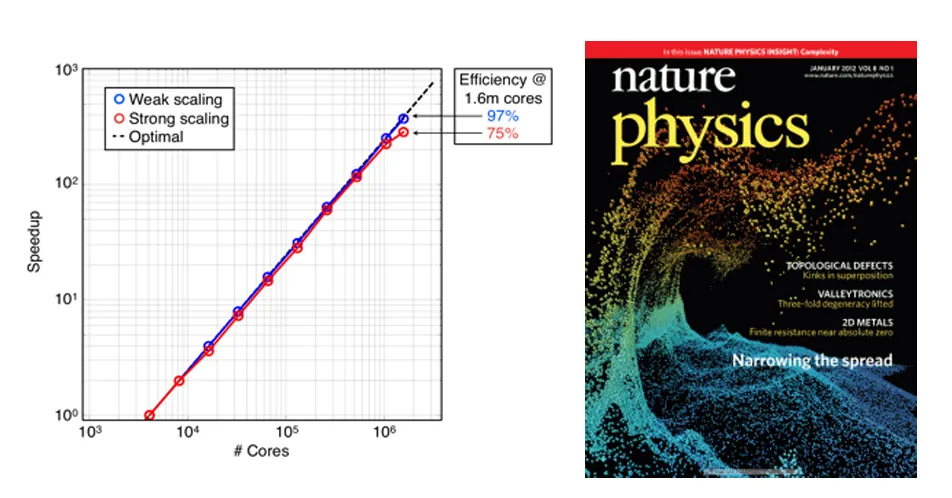
Figures: Figure 1 (left): Figure 1: Weak and strong scaling results on the Sequoia supercomputer at LLNL. For weak scaling, OSIRIS is shown to be > 97% efficient on > 1.5 million cores. For strong scaling, the code is 79% efficient on the full Sequoia machine; Figure 2 (right): OSIRIS simulation from the discovery of a laser-plasma acceleration mechanism that generates 20 MeV proton beams with a 1% spread, shown on the Nature cover.
OSIRIS is written in an object-oriented style in modern Fortran, which allows for the re-use of highly reliable legacy Fortran code while allowing for the rapid development of new modules. Over the years, many new features have been added that improve both the speed and functionality of OSIRIS. The use of higher order particle shapes permits the use of large cells (compared to the Debye length) without numerical heating. It can use either momentum (uniform) or energy conserving (non-uniform) field interpolation. It can run using a moving window to efficiently model short pulses and it has Perfectly Matched Layers for absorbing electromagnetic waves at the boundaries. The parallelization is done either using domain decomposition with MPI across all cores or by using a hybrid approach where MPI is used across nodes and OpenMP is used to launch threads on the cores on a node. It also has dynamic load balancing routines for the MPI piece. There is a relativistic two body Coulomb collision model as well as a beta version of a hybrid algorithm (OSIRIS-H, [3]) which pushes particles throughout all regions including collisions, but in a high density region (collisional) MHD field equations are used to solve for the fields. The MHD field equations do not support high frequency waves so larger time steps can be used. This could be of use when modeling ion acceleration from laser-solid interactions. OSIRIS can model laser wakefield acceleration in a Lorentz boosted frame and solve for the laser fields using an envelope equation and a ponderomotive guiding center pusher for the particles.
OSIRIS can also be run in quasi-3D using hybrid r-z PIC with a gridless phi. The fields (including currents) are expanded into an arbitrary number of azimuthal harmonics. This allows modeling lasers and plasma waves with the correct self-focusing geometry in which the spot sizes have nearly azimuthal symmetry. A hybrid FFT/finite-difference field solver can eliminate the numerical Cerenkov instability. OSIRIS is also the engine behind our educational JupyterPIC notebooks.
Visualization and data analysis
Visualization and data analysis are an essential and nontrivial part of any parallel numerical infrastructure. Members of the OSIRIS Consortium at UCLA and IST, led by R. A. Fonseca, developed a sophisticated set of data analysis and visualization routines based on IDL, called VisXD. For Python users, we maintain pyVisOS, a framework for analyzing and visualizing OSIRIS HDF5 output. The data in our production codes is written in HDF5 so that output can be easily viewed from other public or private analysis and visualization routines. Other analysis routines commonly used are Matlab and Visit. Examples from VisXD and Visit are shown below. We have also developed diagnostics and analysis tools specific to the study of the nonlinear optics of plasmas. These include diagnosing the reflection and absorption of laser light and the energy flux of electrons crossing virtual or real boundaries in the plasma.
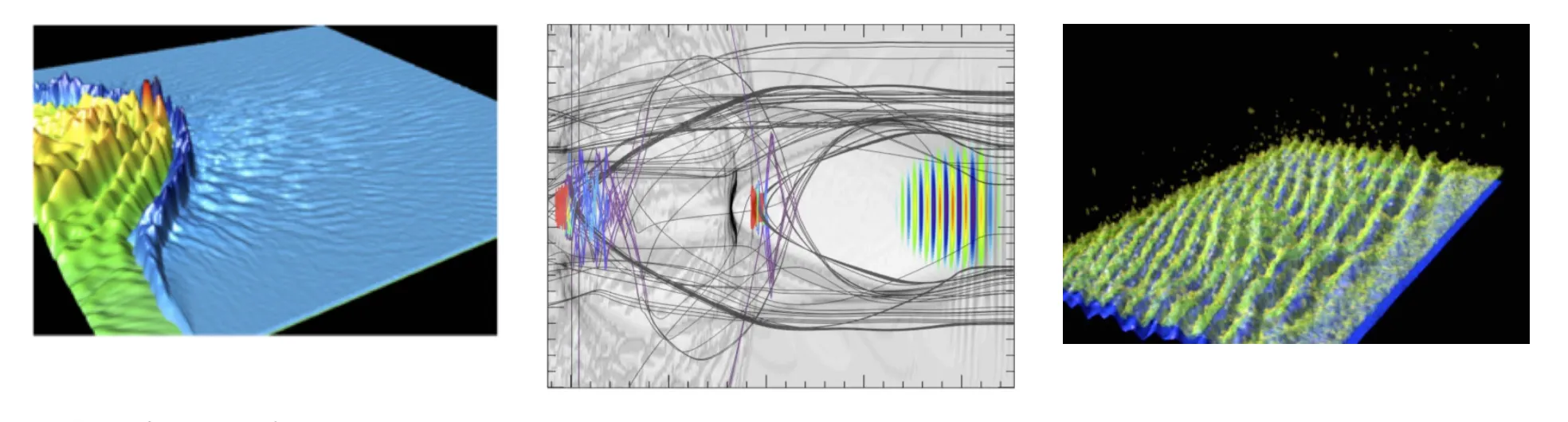
Figures: Figure 3 (left): Figure 3: Images of laser and density in a fast ignition relevant simulation; Figure 4 (middle): Laser and plasma density from a laser wakefield simulation. We can tag particles of interest and plot their trajectories; Figure 5 (right): Plasma waves and electrons in a High-Frequency-Hybrid-Instability simulation showing how the hot electrons are affected by a spectrum of plasma waves.
References
[1] R. G. Hemker, “Particle-In-Cell Modeling of Plasma-Based Accelerators in Two and Three Dimensions,” Ph.D. dissertation, University of California, Los Angeles (2000). Arxiv link
[2] R. A. Fonseca, L. O. Silva, F. S. Tsung, V. K. Decyk, W. Lu, C. Ren, W. B. Mori, S. Deng, S. Lee, T. Katsouleas, and J. C. Adam, Lecture Notes in Computer Science (Springer, Heidelberg, 2002), Vol. 2331, pp. 342–351; R. A. Fonseca et al, “One-to-one direct modeling of experiments and astrophysical scenarios: pushing the envelope on kinetic plasma simulations,” Plasma Phys. Control. Fusion 50, 124034 (2008). doi link
[3] F Fiuza, M Marti, R A Fonseca, L O Silva, J Tonge, J May, and W B Mori, “Efficient modeling of laser–plasma interactions in high energy density scenarios,” Plasma Phys. Control. Fusion 53, 074004 (2011). doi link
[4] R. P. Lee, J. R. Pierce, K. G. Miller, M. Almanza, A. Tableman, V. K. Decyk, R. A. Fonseca, E. P. Alves and W. B. Mori, “Acceleration of the particle-in-cell code Osiris with graphics processing units,” J. Plasma Phys. 91, E8 (2025). doi link